
티스토리 뷰
The bitwise AND operation with 255 is really helpful in keeping the lowest 8 bits and remeoves the negaitive sign bits added during int conversion.
For example,
A C program in Embedded System is trying to send some data to external java program.
C has uint8_t type, this type is 1byte and has value of 0~255 range.
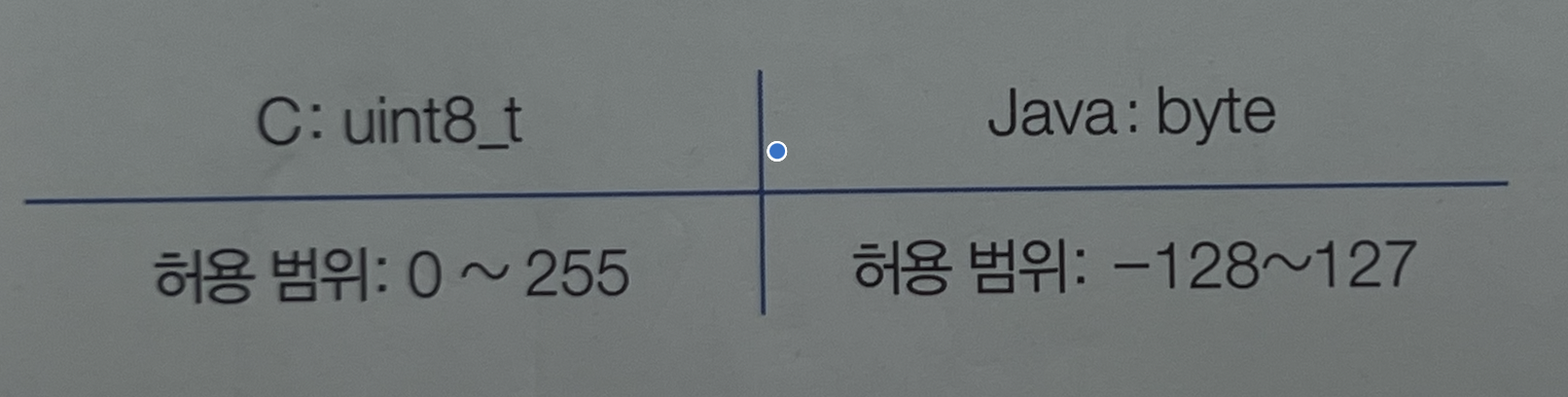
If the C program sent the 136 in binary, uini8_t type, java read this binary as -120.
Because, if the leftmost bit of the full bits, java perceives it as negative.
So, if you want to restore 120 to 136 that C program sent, you should perform bitwise AND operation.
The process of this looks like below.
byte receiveData = -120;
int unsignedInt = receiveData & 255; // 136
To go into detail in memory,

In here, you might have a question.
Why we perform bitwise AND operation with 255??
255 has eight 1s in binary, so AND operation with it keeps only the lowest 8 bits and removes the negative sign bits added during int conversion.
In other words, we use "& 255" operation to see that number of 8 bits in 0~255 range.
( unsigned, not signed(-128 ~ 127) )
+)
The sign is determined by the leftmost bit of the full type.
For byte (1byte),
0xxxxxxx → positive
1xxxxxxx → negative
For int (4byte),
0xxxxxxxxxxxxxxxxxxxxxxxxxxxxxxx → positive
1xxxxxxxxxxxxxxxxxxxxxxxxxxxxxxx → negative
----------------------
Tomorrow, I'm into My university's dormitory...!!!!!!!!
I'm super excited!!!!!!!!